

US
°C




Hurricane Ian slammed ashore in southwest Florida at Category 4 intensity on Sept. 28, 2022. Its peak surge of over 15 feet and wind gusts to 140 mph leveled much of Fort Myers Beach and Sanibel Island. Ian produced record inland flooding in the Florida Peninsula, including near Orlando, that would last for weeks. Ian was the costliest hurricane on record to hit Florida. Ian later made a second landfall in South Carolina, spreading storm surge and high winds from northeast Florida to the Carolinas. (AP Photo/Wilfredo Lee)
Tropical cyclones that are so destructive and/or deadly can be retired from future name lists.Through 2022, 96 Atlantic hurricane or tropical storm names had been retired.
Sign up for the Morning Brief email newsletterto get weekday updates from The Weather Channel and our meteorologists.
Some Atlantic Basin hurricanes and tropical storms have had their names retired.
Just as no New York Yankee will ever again wear No. 3 (Babe Ruth), nor will a Green Bay Packer ever claim No. 15 (Bart Starr), no future Atlantic hurricane will ever be named Harvey, Irma, Katrina, Maria or Sandy.
Unlike an athlete's number, however, there is no celebration when an Atlantic name is retired from future use.
Contrary to popular opinion, a committee of the World Meteorological Organization – not the U.S. National Hurricane Center – is responsible for the tropical cyclone name lists.
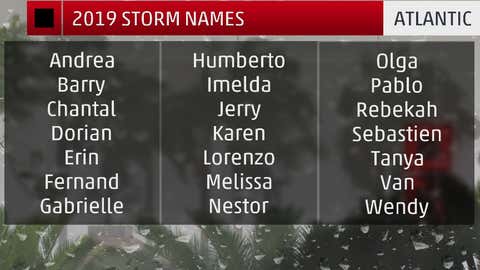
Atlantic hurricane and tropical storm name lists repeat every six years, unless one is so destructive and/or deadly that the committee votes to retire that name from future lists. This avoids the use of, say,Katrina, Sandyor Maria to describe a future weak, open-ocean tropical storm.
Since the naming of Atlantic tropical cyclones ditched the phonetic alphabet in 1953, 96Atlantic tropical cyclone names have been retired, including 2022's , 2021's , 2020's , 2019's , 2018's and , and 2017's , , and .
Only 19 seasons have not had a name retired, most recently in 2014. Another 27 seasons, through 2022, have had multiple names removed from future use, led byfive retirees.
Names beginning with the letter "I" lead the retirees with 13, followed by 10 "F" storms, then nine "C" storms. Eleven of those "I" storms have earned retirement just since 2001, including a four-year streak from 2001 through 2004 (Iris, Isidore, Isabel and Ivan, respectively).
Wilmain 2005 has been the deepest-in-the-alphabet retiree until 2020, when by the WMO, along with any future use of the Greek alphabet for hurricane names once a season's list runs out.
Some names you'll instantly recognize. Others, not so much.
For example,,andWilmaare the big three you undoubtedly remember from 2005. You may have forgotten aboutDennisand, however. Did you know?
The retired Atlantic storms weren't all necessarily intense hurricanes. In fact, a good number of them were retired due to their deadly flooding in the Caribbean, Mexico, Central Americaor the United States.
Some examples of this include,in Mexico,in Puerto Rico andin the eastern U.S.
Only two Atlantic retirees never attained hurricane status: 2015's Tropical Storm Erika and 2001's. Damage from Erika's epic flooding, according to the country's prime minister in late-summer 2015.
Allisonwas a $14.2-billion storm and one of the worst floods of record in Houstonuntil 2017's .
The Weather Company’s primary journalistic mission is to report on breaking weather news, the environment and the importance of science to our lives. This story does not necessarily represent the position of our parent company, .




 zpostcode
 Recruit
 weather
 mreligion
 Yellowpages
 sport
sport constellation
 shopping
 name
name game
game directory
 literature
 Word
Word tour
tour furnish
 Lottery
 tftnews
 lyrics
 News
News digital
 car
car dir
dir Edu
Edu Finance


