

US
°C




Veteran meteorologist Michael Brennan was recently named director of the National Hurricane Center.Communicating risk is one of the most rewarding and most challenging parts of the job, Brennan said.He wants people to remember there's a human face behind every forecast.
Sign up for the Morning Brief email newsletter to get weekday updates from The Weather Channel and our meteorologists.
Ask almost any meteorologist what made them get into the field and they’ll likely tell you it was a childhood experience.
Michael Brennan, the new director of the National Hurricane Center, is no different.
For him, it was flooding in his hometown of Roanoke, Virginia, from the remnants of in 1985.
“It was a very impactful event for me personally,” Brennan told weather.com in an interview Tuesday. “I was 7 or 8 years old, and my grandmother lost her home in that event.”
(MORE: 12 Things You May Not Know About Hurricane Forecasts)
That memory helped push him to where he is today. Brennan, who holds a doctorate degree in atmospheric sciences from North Carolina State University, was director of the NHC on Monday, after 15 years serving in various roles there.
During that time, 25 named storms have made landfall in the continental United States, causing nearly in damage and the deaths of hundreds of people.
Roughly of those storms came in the last three hurricane seasons, from Barry in July of 2019 to Nicole in November of 2022.
“We've had a lot of impactful storms the last few years and a piece of each one of those sticks with you afterward,” Brennan said.
National Hurricane Center Director Michael Brennan
(NOAA)
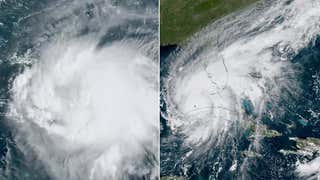
Two in particular stand out to Brennan during his tenure at the NHC so far — , which brought nearly 13 feet of storm surge to parts of New York’s Long Island in October 2012, and Category 5 six years later, which brought winds up to 160 mph to the Florida Panhandle.
Communicating risk to the public about the dangers of deadly storms like those is among the most challenging — and most rewarding — part of working at the NHC, Brennan said.
“There are people out there who are trying to hype up events, trying to scare people. And that’s not what we’re trying to do,” he said. “We're trying to give people clear, concise information in a calm way that helps them take the actions they need to protect their lives.”
(MORE: Why the Projected Path For Hurricanes, Tropical Storms Doesn't Always Tell the Full Story)
In an active hurricane season, the NHC might issue dozens of different updates, watches, warnings and graphics in a single day. The cone of uncertainty is among the most familiar, and most closely watched.
It’s also often what the public latches on to, despite the fact that it is a broad prediction that doesn’t drill down on the most dangerous storm impacts, including deadly storm surge and flooding.
“When you think about the cone graphic, it's a high-level product that sort of gives you a general idea of where the center of the storm is likely to go,” Brennan said. “But it's sort of like the cover of a book. It doesn’t tell you the details.”
Brennan’s staff is studying potential changes.
“We are looking at, what could we do differently with the cone? Could we have a cone that encompasses more of the track forecast uncertainty? Should we try to show different information on that? That's stuff we're starting to work on or we've actually been working on,” he said.
A seven-day track forecast could also be in the cards at some point, versus the current five-day view.
That would be in line with a similar change made in tropical weather outlooks for this hurricane season.
That switch was made possible by better modeling technology, Brennan said.
(MORE: Changes You’ll See In Tropical Forecasts This Hurricane Season)
He pointed out that such revisions don’t come quickly. Besides the meteorology behind it all, social scientists are also involved to make sure the information is in a format that people can easily digest and take action on.
Most of the more specific information that people need is included in watches, warnings and other forecast products that, for whatever reason, don’t always get as much attention from the public.
Information from the National Hurricane Center also helps inform local decisions on when to issue evacuation orders and take other lifesaving measures.
Ian is seen in the Caribbean Sea just south of Cuba in this photo taken by a crew member on the International Space Station on Sept. 26, 2022. NASA Earth Observatory
((NASA Earth Observatory))
“Pay more attention to what the watches and warnings mean and pay attention to that advice you're getting from your local officials because they're going to tell you what you need to do to be safe, whether it's evacuate or take out some other precautions,” Brennan said.
He added that flood forecasts, watches and warnings in particular will become more important in the coming years as climate change drives higher sea levels and more intense rainfall.
(MORE: Hurricane Season Terms You Need to Know)
But no matter what the messaging might be, there are still people who don’t heed the warnings. Brennan hopes to convince them to trust the experts.
“There's a human being behind every piece of information that comes out of this building in terms of the forecast, the watches and warnings, the messaging, the words we choose, how we convey information,” Brennan said.
“Turn to us, your local weather service office, your local emergency management officials, your trusted sources and local media and we'll get you through just about anything.”
The Weather Company’s primary journalistic mission is to report on breaking weather news, the environment and the importance of science to our lives. This story does not necessarily represent the position of our parent company, .




 zpostcode
 Recruit
 weather
 mreligion
 Yellowpages
 sport
sport constellation
 shopping
 name
name game
game directory
 literature
 Word
Word tour
tour furnish
 Lottery
 tftnews
 lyrics
 News
News digital
 car
car dir
dir Edu
Edu Finance


