

US
°C




Ian and Fiona will not be used for future Atlantic tropical storms or hurricanes. Storms that are notoriously deadly and/or destructive have their names retired from future use.Atlantic hurricane names have been retired since 1954.
Sign up for the Morning Brief email newsletterto get weekday updates from The Weather Channel and our meteorologists.
Two names from the 2022 Atlantic Hurricane Season - Ian and Fiona - have been retired and will not be reused again.
Storm names are removed from the list when storms associated with those names cause catastrophic damage and/or significant loss of life.
Atlantic tropical storm and hurricane name lists repeat every six years unless a storm fits either of these categories. This avoids any confusion or insensitivity over the use of particularly infamous storms like Harvey, Katrina, Maria or Sandy to describe another future storm.
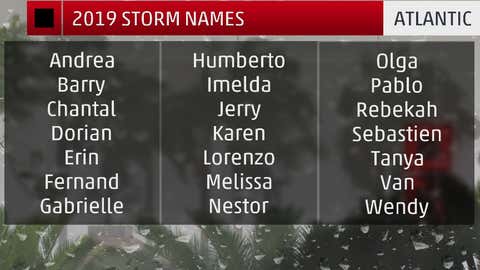
In 2028, the “F" and "I” names will be “Farrah” and "Idris.”
A committee of the World Meteorological Organization – not the U.S. National Hurricane Center – is responsible for the tropical cyclone name lists.
Recently, almost all retired names were associated with a billion-dollar disaster and a tremendous loss of life.
This year’s list is no exception to that.
The 2022 retired storms combined for a total of $115 billion dollars in damage and 179 lives lost.
Hurricane Ian was the costliest hurricane on record to hit Florida.
Hurricane Ian initially plowed into western Cuba, and flooding some areas in .
Ian then intensified before it slammed ashore in southwest Florida at Category 4 intensity on Sept. 28. Its peak storm surge was and wind gusts up to 140 mph leveled much of Fort Myers Beach and Sanibel Island.
(FULL RECAP: Hurricane Ian)
Ian went on to produce record inland flooding in several locations in the Florida Peninsula that would last for well over a week, and produced storm surge flooding and high winds along the coast from northeast Florida to the Carolinas, including Pawleys Island and Myrtle Beach, South Carolina.
At least 150 people were killed either directly by Ian, or during its aftermath, 119 of which occurred in Florida. That makes Ian .
(MORE: Ian Joins a Long List of Retired 'I' Names)
Hurricane Fiona was an intense mid-hurricane season storm that made landfalls in Puerto Rico, the Dominican Republic, the Turks and Caicos and in Canada, setting new records and causing destruction in multiple countries along the way.
Hurricane Fiona hammered and the with up to 32 inches of rain and Category 1 winds, causing widespread flash flooding, downing numerous trees and triggering an island-wide power outage for Puerto Rico's 3.2 million residents.
Thousands of water rescues were performed and a flash flood emergency was issued. Some river levels broke records previously set by Hurricane Maria five years earlier. Fiona caused $2.5 billion in damages on the island alone, making it the on record for the territory.
Fiona then slammed into Atlantic Canada on Sept. 24 as a post-tropical cyclone, the with a minimum pressure of 932.7 mb.
Storm surge and battering waves . High winds downed numerous trees and rainfall flooding was widespread in Nova Scotia, Prince Edward Island, eastern New Brunswick, western Newfoundland and even southeastern Quebec. Gusts up to 111 mph were measured in Nova Scotia. At least one estimate places Fiona as the .
(FULL RECAP: Hurricane Fiona)
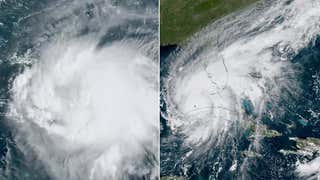
Visible satellite images of Fiona's landfalls, first in Puerto Rico (at right) and as a post-tropical cyclone in Atlantic Canada (at left.)
(NASA Worldview)
Fiona is responsible for the deaths of and more than two billion dollars in losses in the U.S. alone. Another $600,000 (USD) in insured damages occurred in Canada. Throughout the Caribbean and Canada, total losses are estimated at $3.09 billion.
Fiona's destruction in Puerto Rico, the Dominican Republic and Atlantic Canada, not to mention setting Canada's all-time low-pressure record, qualified it for retirement.
Since the naming of Atlantic tropical cyclones ditched the phonetic alphabet in 1953, 96 Atlantic tropical cyclone names have been retired, including 2021's , 2020's , 2019's , 2018's and , and 2017's , , and .
Only 19 seasons have not had a name retired, most recently in 2014. Another 27 seasons, through 2021, have had multiple names removed from future use, led by .
The . Each was responsible for at least $8.7 billion in damage in the U.S., according to NOAA.
The next hurricane season isn’t far away.
Educate yourself on what you need to know this hurricane season. Here's a reading list to get you started:
The Weather Company’s primary journalistic mission is to report on breaking weather news, the environment and the importance of science to our lives. This story does not necessarily represent the position of our parent company, .




 zpostcode
 Recruit
 weather
 mreligion
 Yellowpages
 sport
sport constellation
 shopping
 name
name game
game directory
 literature
 Word
Word tour
tour furnish
 Lottery
 tftnews
 lyrics
 News
News digital
 car
car dir
dir Edu
Edu Finance


