

US
°C




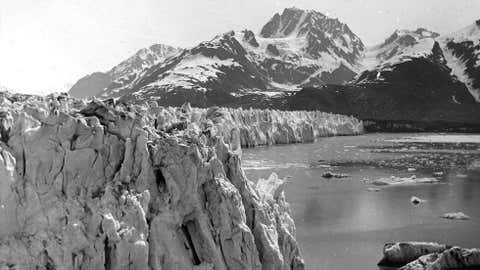
Since the 1980s, the rate of ice loss from Greenland has grown six-fold.Between 1980 and 1990, approximately 51 billions tons of ice were lost from the world's second-largest ice sheet.That amount jumped to 286 million tons, a six-fold jump in ice loss, between 2010 and 2018.
The Greenland ice sheet is melting even faster than previously thought, a new study says.
Since the 1980s, the has increased six-fold, according to the study published Monday in the Proceedings of the National Academy of Sciences.
Between 1980 and 1990, approximately 51 billions tons of ice were dumped from the world's second-largest ice sheet into the oceans as a result of global warming. Between 2010 and 2018, that amount jumped to 286 million tons, a six-fold jump in ice loss.
“The when the Earth’s climate started to drift significantly from its natural variability as a result of man-made emissions of greenhouse gases,” study co-author Eric Rignot, an Earth systems scientist for the University of California at Irvine and NASA, told the Washington Post.
The researchers used three methods of measurement that were confirmed by field calculations to come up with their findings.
Lasers on satellites were used to measure altitude on the ice sheet to measure ice loss. The scientists also measured variations in gravity which shows ice loss through a decrease in gravitational pull. Finally, they used known as mass balance models, which compare mass accumulation from rain and snow to mass lost to ice river discharges to calculate what remains, phys.org reported.
The researchers then took the three methods and went "back in time" to re-analyze the limited data that was available back in the 1970s and 1980s.
"When you look at several decades, it is best to sit back in your chair before looking at the results, because it is a bit scary to see how fast it is changing," Rignot told phys.org.
The researchers noted that of the 14 millimeters (0.55 inches) of global sea-level rise since 1972, half occurred within the past eight years.
What the future holds for the 20,000-square-mile ice sheet is still uncertain, Rignot said. Today, parts of Greenland have not melted as quickly as other areas, including the far northwest, which has the greatest potential for ice loss. Should these areas begin to catch up with the rest of Greenland, the rate of melt will accelerate substantially.
“The entire periphery of Greenland is affected. I am particularly concerned about the northern regions, which host the largest amount of potential sea-level rise and are already changing fast,” Rignot told the Post.
Should the whole ice sheet melt, , wiping out islands and coastal regions worldwide, home to 40 to 50 percent of the world's population.
(MORE: New, Easier to Recycle Plastic Could Be a Game-Changer For Recycling Efforts)
The causes of the increased ice melt are two-fold: warmer air temperatures as a result of global warming have melted more ice on the surface and warmer water originating from the Atlantic has begun to compromise the glaciers from beneath.
While it's likely too late to prevent a certain amount of ice loss, considering the amount of greenhouse gasses that continue to be emitted worldwide, Rignot says there is still a small opportunity to curb the amount of ice melt in both Greenland and Antarctica.
“If we do something now, it will take 30 years to affect the climate and another few decades to turn the melt down of glaciers, so probably half of that signal is already written in stone,” he told the Washington Post. “But the impact sea level will have on humanity increases with every [4 inches] of sea-level rise, and right now we are about to commit to multi-meter sea-level rise in the coming century if we don’t do something drastic.”






 zpostcode
 Recruit
 weather
 mreligion
 Yellowpages
 sport
sport constellation
 shopping
 name
name game
game directory
 literature
 Word
Word tour
tour furnish
 Lottery
 tftnews
 lyrics
 News
News digital
 car
car dir
dir Edu
Edu Finance


