

US
°C




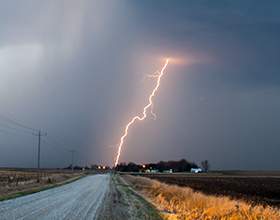
Weather plagued the launch all week.Liftoff was scrubbed three days in a row leading into the weekend.The launchpad was hit by lightning Thursday.
Sign up for the Morning Brief email newsletterto get weekday updates from The Weather Channel and our meteorologists.
SpaceX's Falcon Heavy rocket launched from Florida Sunday evening after several weather-related delays.
The rocket lifted off at about 8:26 p.m. eastern time when high winds calmed around the launch pad.
Heading into the weekend, the Falcon Heavy launch was scrubbed three days in a row. At least one of those, on Thursday, was blamed specifically on the weather but storms were a concern all three days.
There was a potential launch opportunity Saturday, but SpaceX opted to skip it due to additional weather concerns.
Thursday's scrub had set the stage for back-to-back SpaceX launches from Florida on Friday, but it was not to be.
The first, a Falcon 9, lifted off as planned around 6:12 p.m. Friday from Cape Canaveral Space Force Station.
The first, a Falcon 9, lifted off as planned around 6:12 p.m. from Cape Canaveral Space Force Station.
The a Falcon Heavy set to launch from the adjacent Kennedy Space Center, was called off with 59 seconds on the countdown clock.
The reason for Friday's scrub wasn't immediately announced. SpaceX tweeted that the "vehicle and payload remain " Engineers had cleared the rocket to fly after the launch pad was Thursday night.
Weather was originally go for the Falcon Heavy on Friday, according to the U.S. Space Force's 45th Weather Squadron, which issues official launch-day forecasts. SpaceX said conditions had later become more favorable during the Heavy launch window.
The schedule at one point had the potential to set a for the shortest amount of time between launches, according to Florida Today. The current record of 90 minutes was set during the Gemini program in 1966, the newspaper reported.
The launch had already been delayed twice before, including on Thursday due to severe weather and several tornado warnings in the area. At least one included Kennedy Space Center, where wind gusts between 47 mph and 60 mph were reported.
A SpaceX Falcon Heavy rocket heads for orbit after launching from pad 39A at the Kennedy Space Center as seen from Cape Canaveral Space Force Station, Florida, on Jan. 15, 2023.
(Paul Hennessy/SOPA Images/LightRocket via Getty Images)
The rocket will carry a payload that includes a broadband communications satellite.
Falcon Heavy is SpaceX's operational rocket, with a thrust at liftoff equal to eighteen Boeing 747 airplanes. Larger than the workhorse Falcon 9, it's the precursor to the Super Heavy, which powered SpaceX's first Starship test flight last week that ended in fiery explosion.
Falcon Heavy's first launch on Feb. 6, 2018, shot a roadster owned by SpaceX founder Elon Musk into orbit, a mannequin named Starman in its driver's seat. There have been a handful of Falcon Heavy launches since then, sometimes bringing big crowds to Florida's Space Coast.
Part of the draw of a Falcon Heavy launch is the potential for a at Cape Canaveral Space Force Station. But this time, the rocket's payload and other factors don't allow for the boosters to be recovered.
Check out these links for more of our space coverage:
-SpaceX Starship Explodes After Liftoff From Texas
-Spectacular 'Blue Marble' Photos Of Earth From Space
-SpaceX Falcon9 Launches Satellite To Monitor Air Pollution
-Relativity Space 3D Rocket Launches From Florida
Jan Childs covers space, climate, news and features for weather.com
The Weather Company’s primary journalistic mission is to report on breaking weather news, the environment and the importance of science to our lives. This story does not necessarily represent the position of our parent company, .






 zpostcode
 Recruit
 weather
 mreligion
 Yellowpages
 sport
sport constellation
 shopping
 name
name game
game directory
 literature
 Word
Word tour
tour furnish
 Lottery
 tftnews
 lyrics
 News
News digital
 car
car dir
dir Edu
Edu Finance


